Talk to your test platform
in plain English.
ContextQA MCP connects your AI assistant (ChatGPT, Claude, Codex, Claude Code, or Cursor) to ContextQA's test automation platform. Create tests, run them, debug failures, and fix bugs — all through natural conversation.
Quick Setup
Choose your client, sign in, then confirm your account and workspace before running your first task.
1. Connect your client
Add ContextQA to ChatGPT
- Turn on Developer mode
In ChatGPT, open Settings → Security and login and enable Developer mode.
- Create the connection
Open Plugins and select +. Name the connection ContextQA, describe it as “ContextQA test automation,” and paste this server URL.
Server URLhttps://mcp.contextqa.com/mcp - Sign in and start a chat
Choose Create and complete ContextQA sign-in when prompted. In a new chat, select ContextQA from the + → More menu.
Developer mode must be available in your account.
Use the hosted HTTPS endpoint above. Cloud connectors cannot reach a server on localhost.
Add ContextQA to Claude
- Open custom connectors
Go to Customize → Connectors → + Add → Add custom connector.
- Add the server
Name it ContextQA and paste this server URL.
Server URLhttps://mcp.contextqa.com/mcp - Finish and sign in
Choose Continue, review the detected OAuth settings, and finish adding the connector. Complete ContextQA sign-in, then enable it in your conversation under + → Connectors.
In a managed workspace, an owner may need to add the connector first. Members then choose Connect.
Use the hosted HTTPS endpoint above. Cloud connectors cannot reach a server on localhost.
Add ContextQA to Codex
- Add the server
Run once in the terminal where Codex runs. This saves the server to your user configuration,
$HOME\.codex\config.toml.Terminalcodex mcp add contextqa --url https://mcp.contextqa.com/mcp - Check the registration
Run
codex mcp get contextqa. - Sign in
Authenticate with
codex mcp login contextqa, then checkcodex mcp list.
- Add the project configuration
Applies only inside this trusted project. Merge this entry into the file; keep existing settings.
.\.codex\config.toml[mcp_servers.contextqa] url = "https://mcp.contextqa.com/mcp" - Sign in
After saving, run
codex mcp login contextqaand restart the active Codex session. Keep OAuth credentials out of this file.
Add ContextQA to Claude Code
- Add the server
Run once from your project. The default local scope makes this server private to you in this project.
Terminalclaude mcp add --transport http contextqa https://mcp.contextqa.com/mcp - Sign in
Run
/mcpinside Claude Code to inspect the server and complete ContextQA sign-in.
- Add the project configuration
Share this configuration with your project. Merge the entry into
mcpServersif the file already exists..\.mcp.json{ "mcpServers": { "contextqa": { "type": "http", "url": "https://mcp.contextqa.com/mcp" } } } - Approve the server
Start Claude Code in the project and approve the project server when prompted.
- Sign in
Run
/mcpto complete ContextQA sign-in.
Add ContextQA to Cursor
- Add the global configuration
Applies to every Cursor project on this machine. Merge this entry into
mcpServersif the file already exists.$HOME\.cursor\mcp.json{ "mcpServers": { "contextqa": { "url": "https://mcp.contextqa.com/mcp" } } } - Sign in
Save, open Cursor’s MCP settings under Customize, and select ContextQA to complete OAuth sign-in.
- Add the project configuration
Applies only to this Cursor project. Merge this entry into
mcpServersif the file already exists..\.cursor\mcp.json{ "mcpServers": { "contextqa": { "url": "https://mcp.contextqa.com/mcp" } } } - Sign in
Save, open Cursor’s MCP settings under Customize, and select ContextQA to complete OAuth sign-in.
Using another MCP client?
Choose Streamable HTTP with OAuth browser sign-in, and use this endpoint:
https://mcp.contextqa.com/mcp2. Authenticate
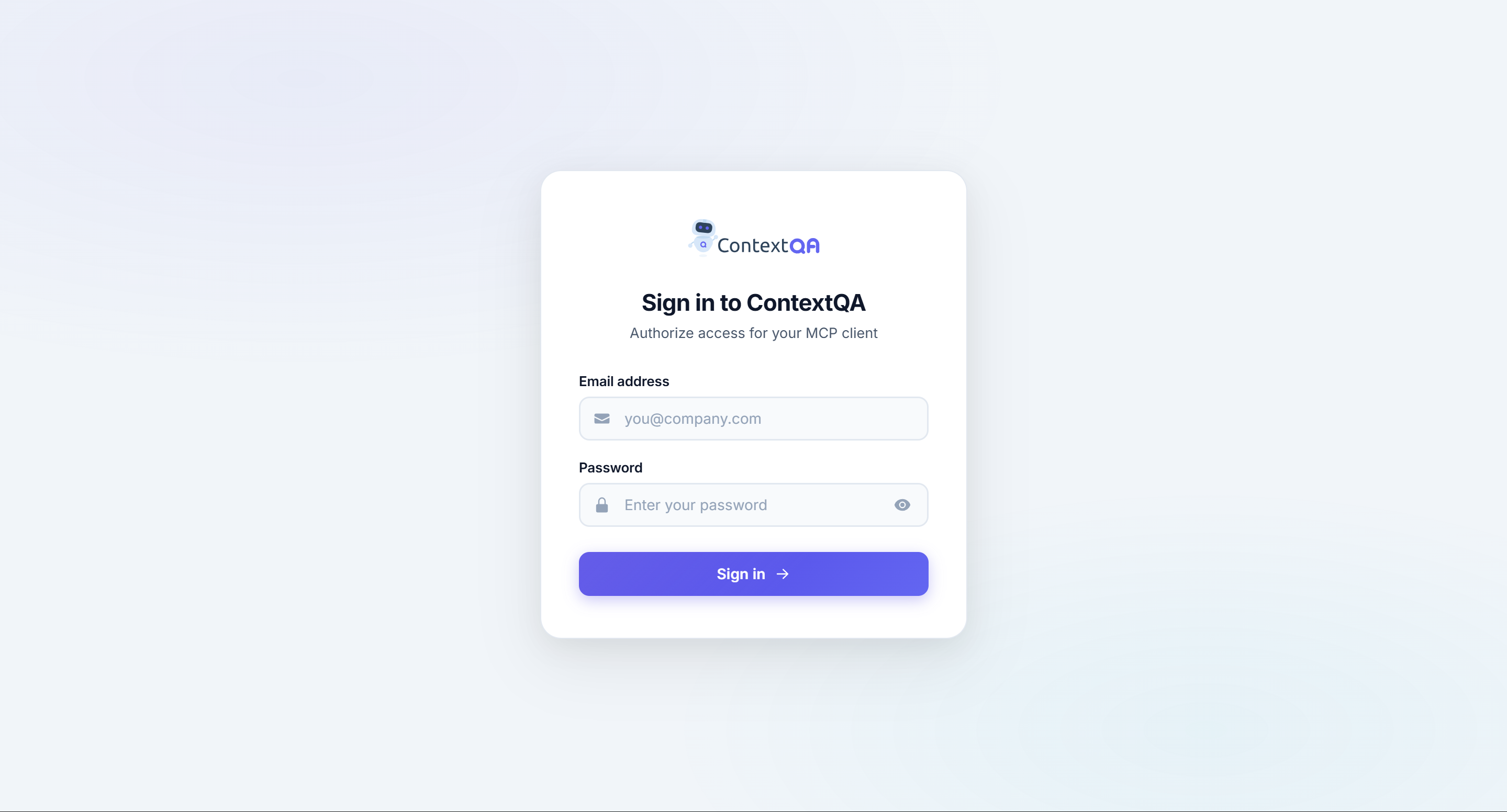
When you first connect, your browser will open a login page. Sign in with your ContextQA credentials. Tokens last 8 hours and auto-refresh.
3. Verify your account and workspace
Ask your AI assistant:
Show who I am signed in as, my organization, and my active workspace.
Then list the first five test cases in that workspace.
Expected result: your account, organization, active workspace, and a list of test cases. An empty list is a valid result when the workspace has no tests.
If the workspace is wrong, ask your assistant to list accessible workspaces and select the intended workspace version. If you receive an authentication or permission error, use FAQ & Troubleshooting.
Once the workspace is correct, choose your first chat example.
Explore the Docs
Everything you need to get productive with ContextQA MCP.
What Can You Do?
Browse the complete tool reference for every accepted parameter, MCP prompt template, and served skill.
| Area | What It Does |
|---|---|
| Account & Workspaces | Identify your user and organization, discover workspaces, and select the active workspace |
| Test Cases & Authoring | Create, edit, search, label, organize, copy, and delete test cases; author typed steps and reuse step groups |
| Elements & Test Data | Manage locators, screens, data profiles, data generators, and global variables |
| Test Generation | Generate tests from code diffs, tickets, requirements, Figma, Swagger, videos, Excel, and n8n |
| Execution & Results | Run browser or mobile cases and test plans; share live links and retrieve completed results |
| Suites, Plans & Folders | Group cases in suites, configure executable plans, and organize cases and suites in folders |
| Environments & Assets | Discover and manage execution environments, typed variables, devices, and uploaded files |
| Debugging & Bug Fixes | Read failure evidence, logs, traces, and recordings; reproduce bugs, verify fixes, and prepare ticket reports |
| Export & Migration | Import server-accessible test repositories and return Playwright project files for your client to save |
| Requirements & Coverage | Read requirements, linked tests, coverage totals, and defects from the organization's Jira integration |
| Integrations & PR Impact | Manage provider connections, Slack channels, enrolled repositories, and PR analysis decisions |
| Organization & Billing | Read onboarding progress, manage execution defaults, inspect credits and usage, and get billing links |
| AI Insights & Knowledge | Get activity insights and create knowledge bases to guide tests |
| MCP Prompts & Skills | Load reusable agent workflows and platform playbooks through MCP tools, prompts, resources, or HTTP |
Describe your task in plain English, or start with a template in the Prompt Library. Test suites group cases; execute them through a test plan.
Quick Reference
The verbs your AI assistant understands best: